
Keep Your Voice: What LVL2's AI Does — and What It Never Does
The fear of bot-sounding booking tools is legitimate. Here's exactly what LVL2's AI handles, what it never touches, and why every booking stays a request you approve.

If you've held off on AI booking tools because you don't want a robot talking to your clients, that instinct is correct. A bot that improvises in your DMs — guessing at prices, faking warmth, promising dates you never agreed to — is a liability, not an assistant. LVL2's AI is built the opposite way: it structures intake and handles the logistics, and every booking stays a request that you personally approve or decline. The AI does the paperwork. You keep your voice, and you keep the final say.
That's the whole design in two sentences. The rest of this post is the detail — where the fear comes from, what LVL2's AI actually does, and the specific things it will never do with your clients.
Where the fear comes from
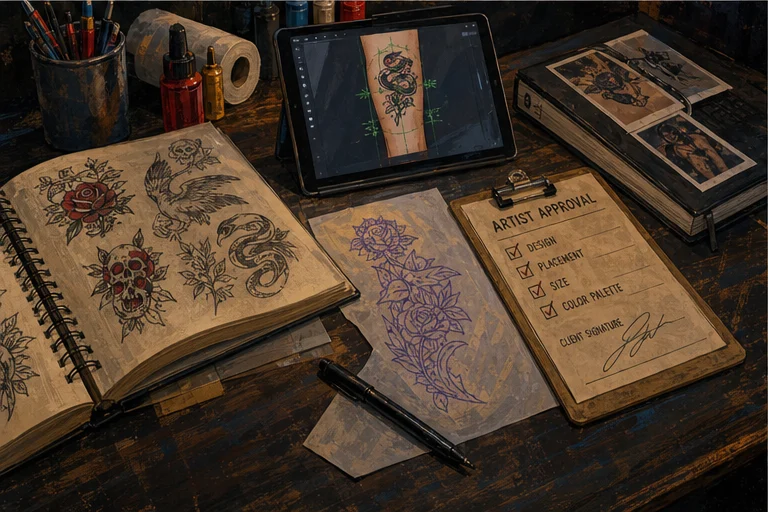
The worry about sounding like a bot isn't paranoia. It comes from watching generic auto-responders do real damage in a trade where trust is most of the sale.
The failure modes are easy to name because almost every artist has seen one:
Wrong pricing quotes. A general-purpose chatbot is trained to be helpful, and "helpful" to a language model means answering the question. Ask one "how much for a forearm piece?" and it will produce a number. If that number isn't yours, you now have a client who feels baited when the real quote lands — and a relationship that starts with an apology.
Fake-warm tone. "Hey lovely!! So excited to create magic with you" — written by software, sounding like no one who has ever held a machine. Clients can smell it. The fastest way to make a shop feel impersonal is a bot trying that hard to feel personal.
Over-promising. "Yes, we can absolutely fit you in Friday!" — sent while you're nine hours deep in a sleeve session and Friday has been booked for a month. The client shows up to a no. The bot doesn't take the reputational hit. You do.
A tattoo isn't a haircut. The work is permanent, clients are nervous, and the conversation before the appointment is part of how they decide to trust you with their skin. Handing that conversation to software that improvises is a real risk, and any tool that won't say so out loud doesn't deserve your booking flow.
What LVL2's AI actually does
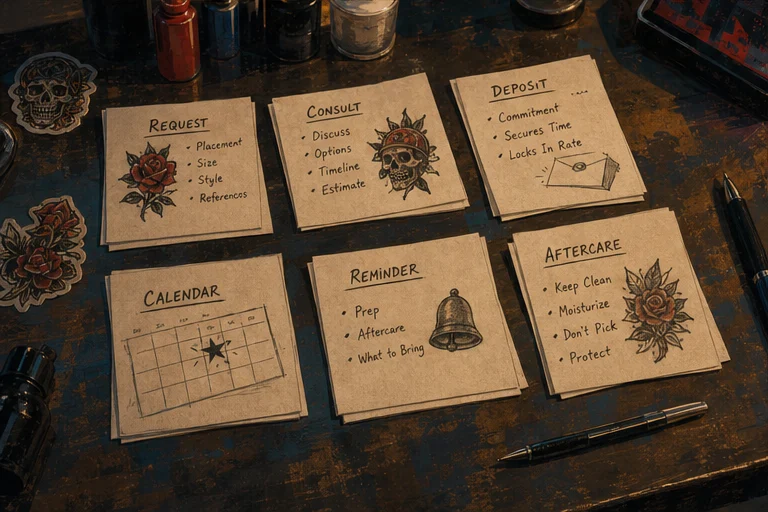
LVL2's AI has a narrow job description, and everything in it is logistics.
It answers the inquiry and starts intake. Clients can text the SMS booking bot to start a booking, check the status of an existing request, or reschedule. No app download, no voicemail, no DM thread that goes cold while you're tattooing all day. The bot fields the logistics question and moves the client into intake. We've written before about what an AI receptionist should and shouldn't handle in a tattoo shop — the short version is: schedule and status, yes; artistic conversation, no.
It collects a structured booking request. Instead of "hey how much for a tattoo," the intake walks the client through what you actually need to make a decision: subject, placement, size, reference images. It's a multi-step flow built for tattoo work specifically, not a contact form with one big text box. Every inquiry arrives as a complete request instead of a forty-message thread you have to mine for details.
It chases the boring stuff. Deposits get collected at booking, reminders go out automatically, and digital waivers get signed before the appointment instead of on a clipboard while your client balances a coffee.
And here is the sentence that matters most: every booking stays a request until you approve it. The AI gathers; the artist decides. Nothing lands on your calendar as confirmed because a bot felt agreeable that day.
Under the hood, LVL2b0t — the AI inside LVL2 — is trained on tattooing and art theory, which is why the intake asks tattoo questions instead of call-center questions. It knows "inner forearm, palm-sized, fine line" is a meaningful sentence. But knowing tattooing is not the same as speaking for the tattooer, and the system never confuses the two.
What it never does
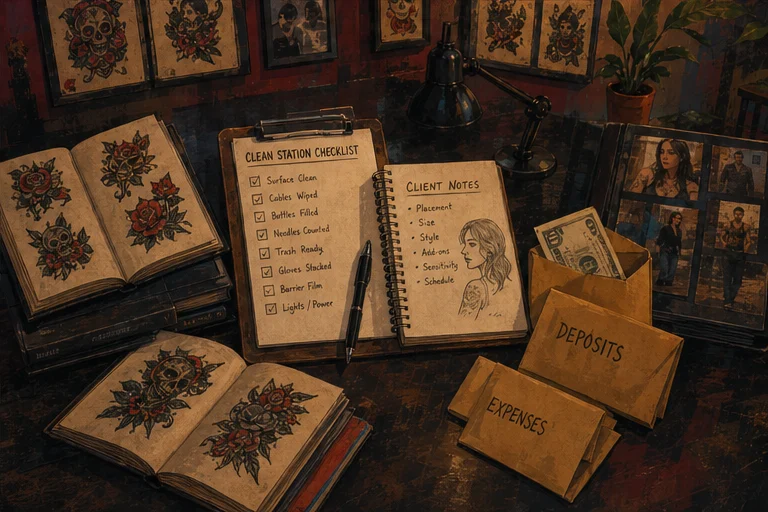
This is the checklist to hold any AI booking tool against, not just ours.
It never invents prices. If you haven't set a price, the bot does not produce one. No "estimates," no "typically ranges from." No number reaches a client that you didn't put into the system yourself.
It never confirms an appointment without you. Booking requests require artist approval before anything is confirmed. The bot can collect the subject, placement, size, and references — but there is no confirmed appointment until you say yes. That approval step isn't decoration. It's how the flow works.
It never decides which projects you take. Maybe you don't do script. Maybe you're done with color realism for the year. Maybe the cover-up someone wants is a bad idea and the right move is talking them out of it. Those are judgment calls, and they belong to the person whose name is on the work. The AI's job is to bring you a clean, complete request so the decision takes thirty seconds instead of thirty messages.
It's worth saying plainly: AI is genuinely bad at the parts of tattooing that matter most. It can't tell whether an idea will age well, whether a placement suits a body, or whether a client's third reference image is quietly a different project than their first two. LVL2 doesn't hand those calls to a model, because nobody should.
Keeping your tone
"But will it sound like me?" Mostly, the honest answer is that it won't try to.
The messages and templates your clients see stay editable, so the words can be yours — your phrasing for deposit asks, your tone for reminders, your way of saying "send me your reference pics." The bot's own voice in the intake flow is deliberately plain: clear questions, no synthetic enthusiasm, nothing performing a personality it doesn't have.
And the client is never sealed off from you. Anyone who wants the human can reach the human — the bot runs the intake flow, it doesn't operate a phone tree. Consults, design conversations, the talk about what the piece means and where it should sit: all of that stays exactly where it has always lived, between you and the client.
The shortest way to put it: the AI is the front desk, not the artist.
Structured beats chatty
Here's the reframe that matters. The point of AI intake was never to imitate you. It's to stop the bleeding of unpaid hours.
Every artist knows the shape of DM chaos: a pricing question with no size or placement, references scattered across three platforms, a thread that runs warm and cold for two weeks and ends in a ghost. We've broken down what those hours actually cost, and the number is ugly — because answering DMs is real work that nobody pays you for.
A chatty bot tries to fix that by sounding human, and it saves the client effort by spending your reputation. Structured intake fixes it the honest way: it asks the client real questions, in order, and hands you a complete booking request at the end. Those are opposite designs. One performs a personality. The other respects everyone's time — including the client's, who would usually rather answer five clear questions than wait three days for a reply.
You don't lose your voice in that trade. You get it back. The evenings you were spending playing receptionist in your inbox go back into drawing, tattooing, and the conversations that actually deserve you.
The bar: would I let it talk to my clients?
LVL2 is built by a tattoo artist who still tattoos, which means every feature gets one filter before it ships: would I let this thing talk to my own clients? A bot that quotes prices it made up, confirms appointments on its own, or gushes in fake enthusiasm fails that test instantly. Structured intake, deposit collection with automatic reminders, digital waivers, and a clean queue of booking requests waiting on your yes or no — that passes.
Your voice books the work. The AI just carries the clipboard. See how the whole flow fits together at /features.
Structure without the robot voice
AI-structured intake that cuts DM chaos while you keep the final say on every booking. Free to start.
Start Free