
How Clients Actually Find Tattoo Artists in 2026
Clients discover artists through more than Instagram now. This guide maps the real discovery stack and how to connect discovery to a cleaner booking path.

The Discovery Myth
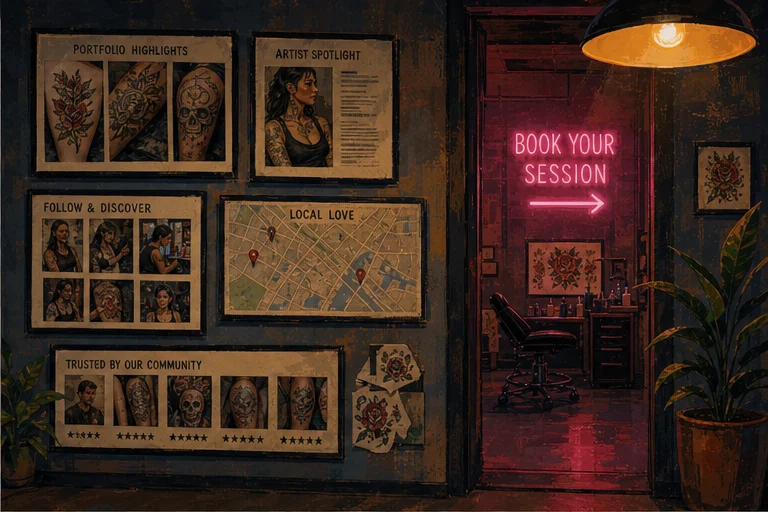
Most tattoo artists think clients find them one way: Instagram. Post good work, get followers, get booked. It worked in the 2010s. It still works to some degree.
But the discovery landscape has fragmented. Clients in 2026 find tattoo artists through a dozen different channels, some of which most artists aren't optimizing for. If you're only focused on Instagram, you're missing the clients who are looking for you somewhere else.
Where Clients Actually Discover Tattoo Artists
1. Instagram (still #1 for discovery)
Instagram remains the dominant discovery platform for tattoo clients, but the nature of the discovery has changed. Clients aren't just scrolling and finding artists organically — they're using Instagram as a visual search engine.
When a client sees a tattoo they like on someone else's body, they save it, screenshot it, and then search for the artist. The discovery path is: "I saw this tattoo on [person], I'm going to find who did it."
For artists, this means your work needs to be visible on bodies — not just in your grid. If a client of yours posts a photo of their tattoo and tags you, that reaches their followers. Your repost or feature amplifies it. The chain of discovery often runs through your clients' posts as much as your own.
The IG Reels algorithm also continues to drive discovery for tattoo content — particularly time-lapse tattoo videos, stencil-to-finished comparisons, and before/after transformations.
2. Google Maps (the one most artists ignore)
When someone types "tattoo artist near me" or "tattoo shop [city]," Google Maps results are the first thing they see. Most tattoo artists have a Google Business Profile — but many haven't optimized it, don't have recent photos posted, and don't have reviews actively managed.
A Google Business Profile with 20+ recent photos, consistent business hours, and 10+ five-star reviews with responses functions as a passive discovery engine. Clients who search geographically find artists based on proximity and rating, not just Instagram following.
3. Artist directories and city pages
Directory-style surfaces give clients a cleaner way to search by city, style, and availability than a generic social feed. On CREW.INK, the public artist directory lives at /artists, where clients browse bookable artists by city. Other directory-style sites play the same role: they catch the client who is already in search mode and wants an organized list, not another endless scroll.
For artists, showing up in a city directory means appearing when clients are actively researching who to book, not just passively browsing.
4. Word of mouth and referral networks
The oldest discovery channel is still one of the most powerful. A client who gets a tattoo from you and loves it will tell their friends — and specifically, they'll say "I got this done by [artist name], here's how to find them." The referral comes with social proof built in.
Referral clients are the highest-converting clients because they come pre-qualified: they already like your work, they already trust you (via the friend who referred them), and they're motivated to book.
5. Tattoo conventions
Conventions remain a high-density discovery event. Clients attend specifically to find an artist. The client who leaves a convention with your business card is a warm lead — they've already invested time in researching and approaching you.
6. TikTok and YouTube (growing)
TikTok has become a discovery platform for younger demographics (18-30). A viral tattoo time-lapse or a "what to expect at your first tattoo" video surfaces artists to audiences who weren't looking for a tattoo before they saw the content.
YouTube functions differently — clients who are further along in their decision process search for "best tattoo artists in [city]" or "tattoo placement guide" and discover artists through long-form content.
What Artists Get Wrong About Discovery
"I need to be on every platform."
Being present on every social platform — Instagram, TikTok, YouTube, Pinterest, Twitter/X — dilutes your content and exhausts you. The question isn't "where should I be?" It's "where are my specific clients looking?" If your work is traditional American style, your clients are probably on Instagram and Google. If you're doing anime/color work, TikTok and YouTube may be more relevant.
"I just need more followers."
Follower count is a vanity metric for most tattoo artists. What matters is: how many of your followers are in your city, interested in your style, and have the budget to book? A 5,000-follower account with 80% local, style-matched followers is more valuable than a 50,000-follower account with followers from across the world who can't book you because you're not nearby.
"My work speaks for itself."
It doesn't. Good work is necessary but not sufficient. Clients need context: who you are, what you specialize in, what the booking process looks like, what your availability is. The artist with slightly less impressive work but a clear, professional discovery presence will book more than the artist with exceptional work and a disorganized social presence.
How to Optimize for Each Discovery Channel
For Instagram:
- Post work consistently (3-5x per week minimum)
- Use Stories for process content; Grid for finished work
- Engage with clients who tag you — repost, respond, amplify
- Use hashtags strategically (city + style, not generic tags)
- Make sure your bio has a booking link that works
For Google Maps:
- Claim and optimize your Google Business Profile
- Post 2-3 photos per week to your GBP
- Respond to every review (positive and negative)
- Keep business hours accurate and current
- Add your service categories and price range
For artist directories and city pages:
- Complete your public profile fully — bio, style tags, city, and your strongest portfolio work
- Keep your booking path current so a client can move from discovery to request without hunting for a link
- Make sure your location and availability context are clear enough that a client knows whether you're a fit
- Use
/artistsor similar directory surfaces as a support channel, not your only discovery bet
For referrals:
- Make it easy for clients to refer you — have a referral link or a "refer a friend" option on your booking page
- Don't be afraid to ask: "If you loved your experience, feel free to send your friends my way"
- Track where your new clients heard about you (CREW.INK's intake form can ask this)
For conventions:
- Have a clear display with your best work and your booking QR code
- Collect client contact info before they leave your booth
- Follow up within 48 hours of the convention
The Discovery Stack for 2026
Not every artist needs every channel. Here's the minimum viable discovery stack:
- Instagram — main discovery channel for most artists. Post consistently, engage with tags, keep booking link current.
- Google Business Profile — passive discovery for local clients. Takes 30 minutes to set up and 10 minutes/week to maintain.
- Artist directory coverage — use your public profile and city-directory presence to show up when clients are actively researching who to book.
- Referral system — ask clients to refer their friends. Make it easy with a referral link.
Everything else — TikTok, YouTube, Pinterest, directory listings — is incremental. If you have the time and energy to maintain another channel, do it. If not, the four above will serve most artists.
The Bottom Line
Clients find tattoo artists in 2026 through a fragmented set of channels — not just Instagram. The artists who are booked consistently are the ones who show up in multiple places where their clients are looking.
You don't need to be everywhere. You need to be where your clients are, with a clear path from discovery to booking. Instagram + Google Maps + a strong public profile/directory presence + a referral mechanism is the foundation. Everything else is growth on top of that.
The work is in making sure that when a client who found you on Instagram, Google, or a referral gets to your booking page, the experience is smooth, professional, and leads to a confirmed appointment. The discovery gets them to the door. The booking system gets them in the chair.
Make discovery lead somewhere useful
CREW.INK gives artists a cleaner path from profile discovery to structured booking instead of DM roulette.
Browse the artist directoryPublic artist discovery lives at /artists. Exchange is CREW.INK's digital marketplace.